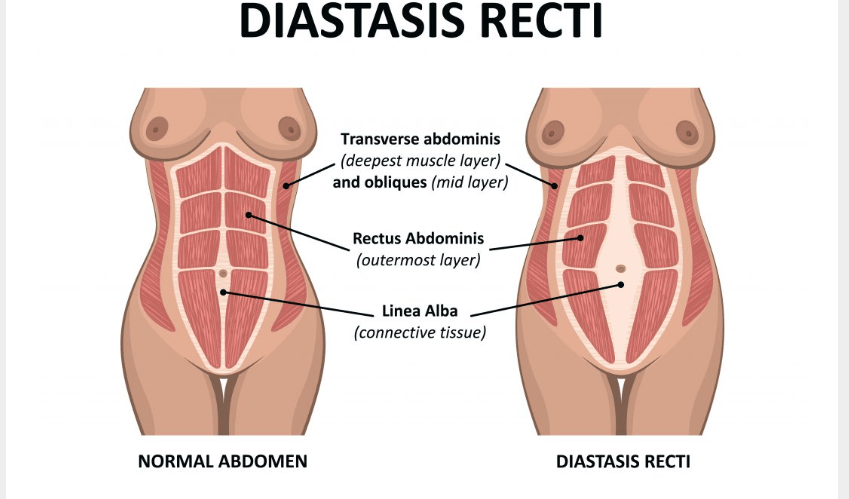
What is it?
With all the momentous milestones post-childbirth many new mums won’t initially notice their Diastasis Recti, or the separating of the abdominal muscles (the rectus abdominus). And yet the condition occurs in around 60 percent of new mothers. For most, the muscles will come back together naturally during the first few months post birth, however for others, it will most likely be a health provider or fitness professional who flags the condition. If, after six-months the seperation remains- then Diastasis Recti is diagnosed.
And, although Diastasis Recti can appear pretty worrisome, the good news is the vast majority of cases can be resolved in anything from a few months to a year- depending on the severity.
Pregnancy induced Diastasis Recti occurs when the abdominal muscles, which are forced apart to make way for the growing bump- do not return to normal after the birth. As the pregnancy develops, a small strip of tissue called the Linea Alba which binds the two abs together, softens and pulls apart- a completely natural process. However, if after the birth, they do not return back to the original position, Diastasis Recti is confirmed.
Types of Diastasis Recti

Separation can occur in three positions: above the belly button, around the belly button and/ or below the belly button. And the severity is measured by how many finger widths apart the abdominal muscles have moved, usually more than 2 fingers is defined as Diastasis Recti.
How to check for Diastasis Recti from birthandbeyond.in
1. Lie on your back in a comfortable position. Bend your knees and put your feet flat on the floor.
2. Place one hand on the midline of your core with your fingers flat on your midline.
3. Place your other hand under your head and neck for support. Lift your head slowly and begin adding pressure through the pads of your fingers.
4. With no diastasis recti, there is the sensation of a toned wall as you lift your direct. If you feel a space, or your fingers sink into your core, you likely have diastasis recti.
5. Repeat the procedure for the areas directly above your belly button down to the pubis to determine whether the diastasis recti is isolated or in your core as a whole.
Additional Issues Associated with Diastasis Recti
- A noticeable “belly-pooch”
- The area around the belly button feels soft or even jelly-like
- Coning or doming during abdominal muscular contraction
- Walking, lifting, or any parts of your normal daily routine become difficult
- Pain during intercourse
- Pelvic or hip pain
- Lower back pin
- Poor posture
- Urine incontinence
- Diarrhoea
- Having weak abdominal muscles
Correcting Diastasis Recti
The good news is that unless your Diastasis Recti is severe, it can be treated or at least, much improved with a quality strengthening programme created by a physiotherapist or fitness professional.
According to the National Institute of Health, with the right interventions, recovery outcomes are good, with mild gaps (2 to 3 cm) healing in around eight weeks, moderate gaps (those between 3cm and 5cm) recovering in 3 to 6 months and severe and persistent gaps requiring up to a year of focused work.
Ideally your programme should include a carefully considered combination of breath-work, pelvic floor work and supportive core exercises, which gently increase in intensity as you grow stronger.
It’s really important to avoid exercises which push the stomach forward, plus anything which causes pain and/or ‘dome-ing’ of the stomach.
It is also important to exhale and focus on drawing the bellybutton to the spine during the exertion phase of each exercise.
If you experience vaginal pain or heaviness, pelvic pressure or urine leakage it’s essential you stop immediately.
Three Beginner Exercises to Start Your Diastasis Recti Recovery
- Pelvic Tilts
2. Knee to Chest Stretch
3. Bent Knee Fallouts
If you are post-partum and would like to discuss your strength, health and fitness goals, and/or start your fitness journey contact me: curstyptsharjah@gmail.com

